

31st August, 2026

Updated: 7 days ago
What am I working on?
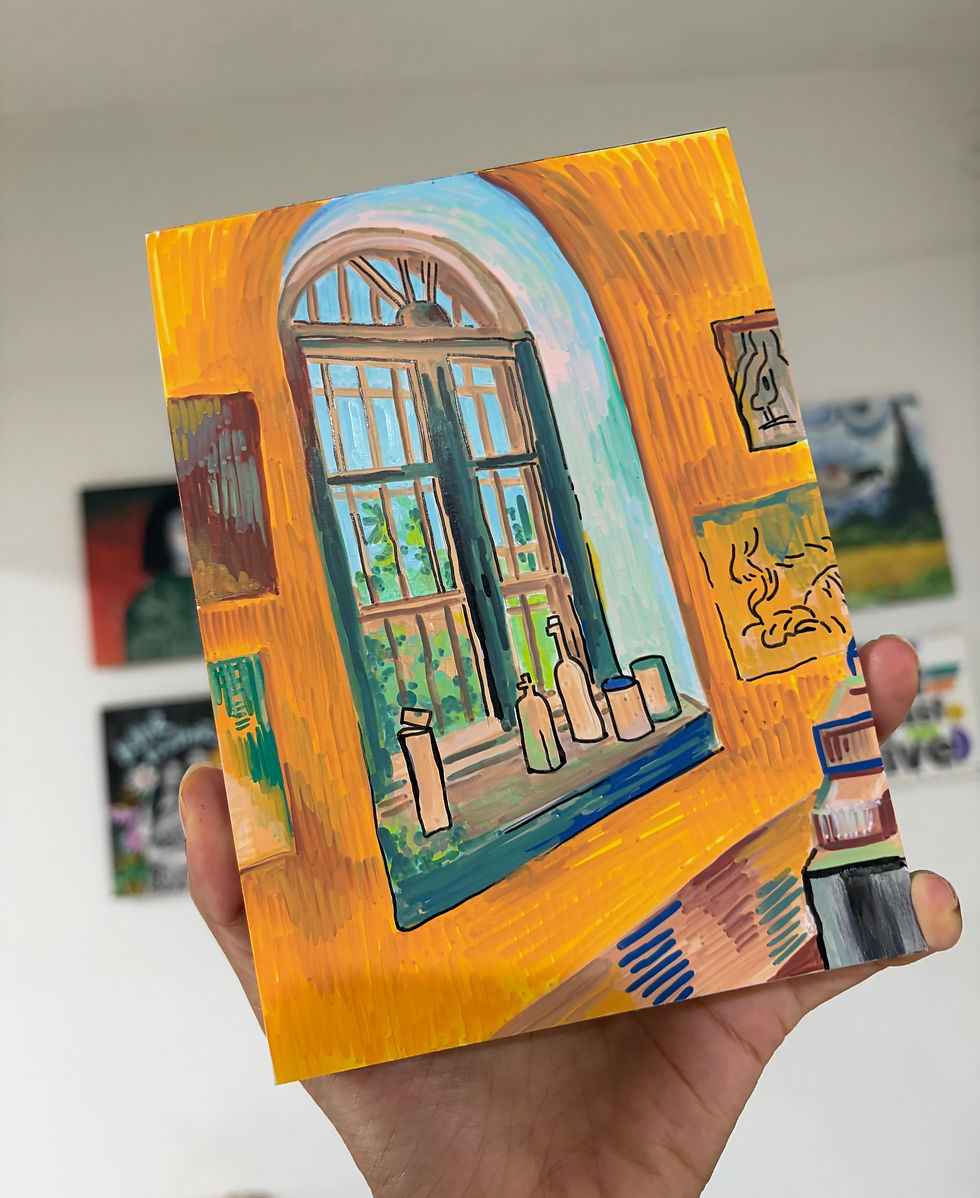
I hosted another session of Artfart last week. If you are new here, you can read about what ArtFart is here. Some glimpses from the session:

What am I reading?
I read Stitches by David Small last week. It is a painfully haunting and critically acclaimed graphic memoir about the artist's childhood growing up in a fractured family, navigating his illness (in a heartbreaking illustration he says my love language was falling ill), and finding freedom through art.
The graphic is divided across chapters that denote his age and the memoir shows his relationship with his parents and brother being raised in an emotionally repressive home: the silent family dinners, visits to his father's workplace where work always came before family, his mother's unpredictable moods and the loneliness he felt in his own home.
Midway the story takes a turn when David discovers a cyst near his neck but more than three years pass before he receives any treatment. What is appalling is the ways in which his parents seem to ignore his existence. Parenting is messy and imperfect, but the absence of care here feels unbearably cruel in this book. The illustrations are black and white with several wordless sequences that capture emotions far more powerfully than dialogue could. Small uses visual metaphors to depict his mother's silent wrath, his nightmares, and his inability to find a voice in the world. There are sections where he shows himself diving into his artwork and art becomes a place where he can escape the reality of his home life.
You might say why anyone would choose to read this? Coz Stitches is not only about neglect and trauma but also a story of resilience. It is about breaking free from the wounds of childhood trauma and using art to get a voice.

What am I watching/watched recently?
I watched The Summit of the Gods last week. It’s a breathtaking and nicely paced animated film that shows the obsession and the thrill of extreme mountaineering.
Makoto Fukamachi, a Japanese photojournalist finds that a vintage camera that could rewrite mountaineering history. The camera is said to have belonged to George Mallory, the British climber who disappeared on Everest in 1924. And if recovered it could provide evidence that Mallory reached the summit nearly three decades before Tenzing Norgay and Edmund Hillary’s historic ascent in 1953. While the story itself is fictional, it is grounded in real events from the world of mountaineering. Fukamachi’s search leads him to Habu Joji, an amazing but disgraced climber who has vanished from public life while preparing for an audacious attempt on Everest’s treacherous southwest face. Habu happens to possess the camera that may hold the answer to one of mountaineering’s greatest unanswered questions. Do you find the answer to that mystery? I will not reveal it - it is for you to watch and find out.
The film is gorgeously animated with many nerveracking scenes that captures the constant dangers of climbing. The landscapes (I added a picture below) are shown in stunning detail and the summit scenes leave you with both awe and terror. More than anything, the film left a simple lesson for me: mountains are unforgiving, but the human spirit is also remarkably resilient.
Also people climb for different reasons. Some seek to conquer fear. Some want to test the limits. Some do it for the journey. And for others, like Mallory famously said, is simply “because it’s there.”
What happens after the summit is reached? The movie says something I never thought about - for many climbers the achievement is not enough. They return in search of an even greater challenge: climbing without oxygen, going solo, or choosing a more dangerous route. The summit is not an ending but the beginning of another obsession.

New thing I learnt lately?
I came across the distinction Dan Ariely makes between social norms and market norms. Under social norms, people do things because they care about others, feel connected or just want to help. Under market norms, the question becomes one of Quid Pro Quo - “What’s in it for me, and what’s the fair compensation?” Ariely’s key insight is that introducing money into a social relationship can destroy the goodwill that was motivating people in the first place. And once you switch to market norms, it is very hard to return to social norms.
I also came across Carlota Perez’s Theory of Technological Revolutions. It illustrates how major technological waves (like electricity, internet and now AI) diffuse through society and economy over a 50 to 60 yr cycle.
Irruption: As a new technology is developed, it enters the cycle of adoption. Perez says new technologies are created during the maturity phase of the last great technology expansion. AI's irruption phase is said to be 2017-2022 with the public launch of ChatGPT in late 2022.
Frenzy: This is a period of massive growth for a new technology. Once a critical mass of consumers has been hit, the diffusion of tech takes center stage with over-investment flooding the market. The AI frenzy is ongoing with massive investment across industries to adopt this along with news of the big companies like Anthropic planning to go public.
Turning point: At some point the bubble has to burst. The turning point is a space for rethinking how the mode of growth that will shape the next few decades. This is something AI would undergo in 2030 (maybe?)
Synergy: Since the foundations and infrastructures had been laid out during the previous phases, conditions are there for expansion and attaining economies of scale.
Maturity: Once again, the cycle continues. During maturity, the stage is set for the decline and for the next technological revolution.


Comments